RAID: Shadow Legends explained: systems, modes and what the game asks of you
This page is advertising-funded. The buttons labelled “partner link” are commercial links. If you install RAID: Shadow Legends through one of them, BUILDKEPITEL WORK s.r.o. is paid a commission by the advertiser. You pay nothing extra — the game is free to download either way — and the commission does not change what is written here. Our editorial policy explains how we keep the two apart, and the advertising disclosure sets out the arrangement in full.
Not an official page. krasoden.online is an independent publication. It is not affiliated with, endorsed by or sponsored by Plarium, Aristocrat Leisure or any other rights holder. Where anything here differs from the publisher’s own information, the publisher’s information prevails.
RAID: Shadow Legends is one of the most heavily advertised mobile games ever made, which means a lot of people have heard of it and very few have had it explained to them properly. This page does the boring part: what the game actually is, which systems drive it, how much of your day it wants, and what money does and does not buy. Where we are not certain of a figure, we say so rather than round it into a claim.
What RAID: Shadow Legends is
RAID: Shadow Legends is a turn-based collection role-playing game. You assemble a squad of fantasy Champions, send them into battles that resolve one turn at a time, and spend the rewards on making that squad stronger so it can survive harder battles. There is no real-time movement, no aiming, no reflex test. The skill in the game is arithmetic and planning: which Champion goes in which slot, which statistics to prioritise, which enemy to debuff first.
It is free to download and free to play through. It also sells things: random Champion summons, energy refills, a battle pass and recurring subscriptions. Both of those statements are true at the same time, and most disagreements about the game come from people insisting on only one of them.
Structurally it sits in a large family of Asian and Eastern European “gacha” collection RPGs. If you have played Summoners War, Epic Seven or a similar title, the shape will be immediately familiar: random hero acquisition, an affinity triangle, gear farmed from repeatable bosses, and a daily checklist.
Who makes it, and where it runs
The game is developed and published by Plarium, a studio owned by the Australian gaming group Aristocrat Leisure. It launched on mobile in 2018 and later added a desktop client, Plarium Play, which shares a single account with the mobile version. Exact per-platform launch dates and the current list of supported devices are best read from the store listings themselves rather than from an article — they change.
Progress is stored on your Plarium account, not on the handset, so the same roster follows you between phone, tablet and PC. That matters more than it sounds: the desktop client is how many long-term players handle the repetitive farming without flattening a phone battery.
Want to see the systems below for yourself?
RAID: Shadow Legends is a free download on the usual mobile stores and on PC. Everything described on this page is visible in the first few hours of play, at no cost.
Download RAID: Shadow LegendsPartner link · advertisementPartner link. If you install the game through it, BUILDKEPITEL WORK s.r.o. receives a commission from the advertiser. The game itself stays free to download and it costs you nothing extra.The core loop: energy in, progress out
Almost every mode in the game is a variation on one loop, and understanding it is the difference between enjoying the game and feeling farmed by it.
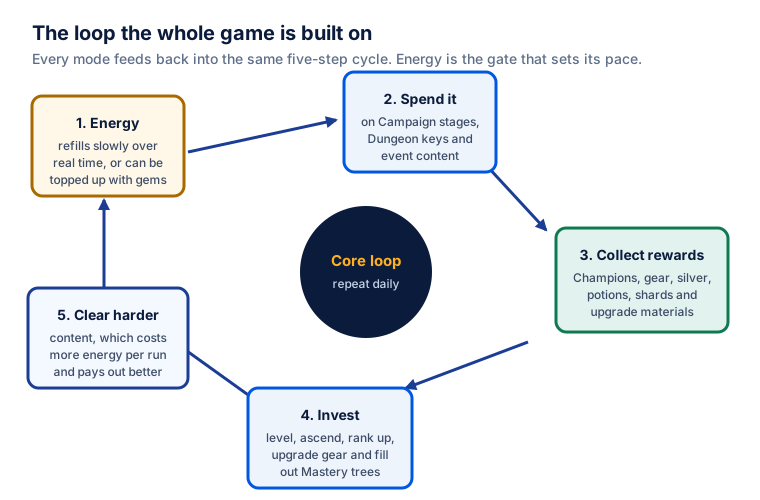
Energy regenerates slowly whether you are playing or not, and each battle costs some. When it runs out you either stop, or you convert the game’s premium currency into more energy. That is the entire monetisation pressure point in one sentence, and it is worth seeing clearly before you start rather than three weeks in.
The healthy way to play against that design is to treat the energy bar as a session timer. Log in, spend what has accumulated, do the handful of daily tasks, and leave. The game is engineered to reward consistency far more than long sessions, and a player who spends twenty minutes a day for a month will be further ahead than one who binges for a weekend and stops.
Champions: rarity, faction, affinity
Champions are acquired mostly at random, by opening shards obtained from play, events or purchases. There are several hundred of them and the roster grows with most content updates, so any specific count printed in an article goes stale quickly — the in-game collection screen is the only figure worth trusting.
Three attributes classify every Champion.
Rarity
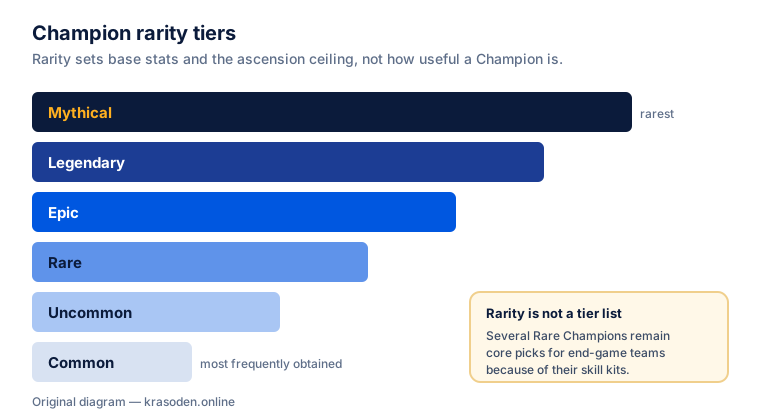
Rarity runs from Common up through Uncommon, Rare, Epic and Legendary, with a Mythical tier added to the game later in its life. Higher rarity means better base statistics and a higher ceiling, but it is not a ranking of usefulness. Several Rare Champions stay in serious end-game teams for years because their skill kits do something specific — a decrease-defence debuff, a turn-meter fill, a revive — that no amount of raw statistics substitutes for. Newer players routinely bench a genuinely good Rare in favour of a worse Epic, and it costs them months.
Faction
Every Champion belongs to a faction — Banner Lords, Undead Hordes, Dark Elves and a dozen or so others, with new factions added occasionally. Faction is mostly flavour in ordinary battles, but it is load-bearing in Faction Wars, a mode that requires you to field a team drawn from one faction only. That single mode is the reason experienced players advise against dismantling mediocre Champions early: a shallow roster locks that content shut.
Affinity
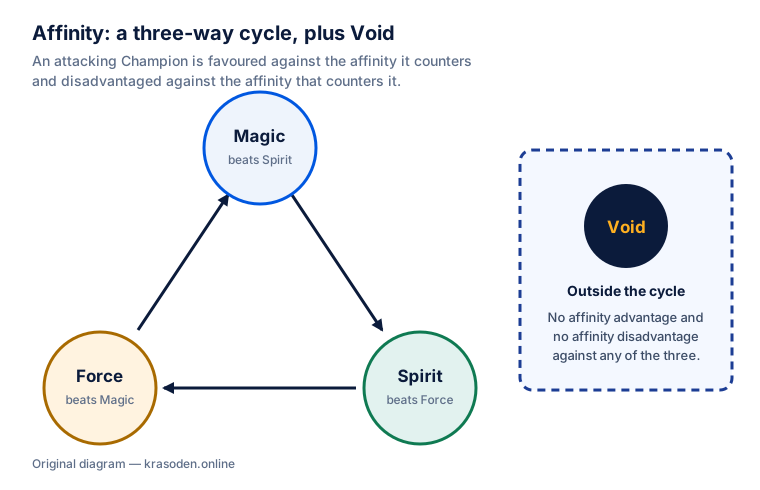
Affinity is a rock-paper-scissors layer sitting on top of every attack. Attacking into the affinity you counter gives you an advantage; attacking into the one that counters you gives the defender one. Void Champions are outside the cycle entirely: no advantage, no disadvantage, which makes them reliable rather than exciting.
Dungeon bosses have fixed affinities, so each Dungeon quietly demands a particular kind of team. This is the mechanic that most often stalls new accounts, and it is invisible until someone points it out.
Building a team that actually works
Most content — Campaign, Dungeons, Classic Arena — is fought with four Champions. Some modes field five. Four slots is not many, which is why team composition matters more here than raw power.
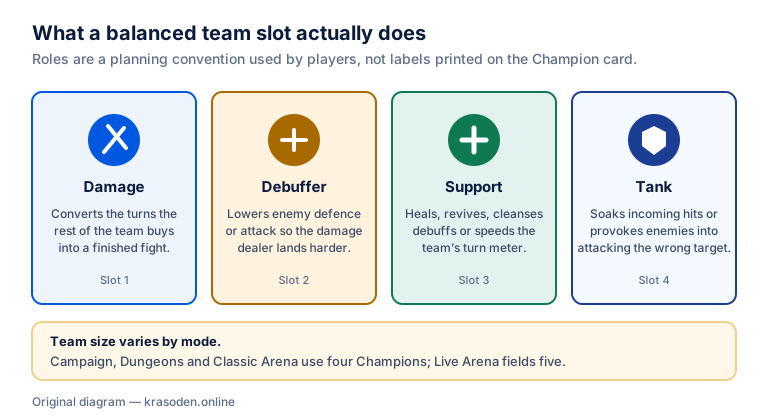
The statistics that decide fights are not the obvious ones. Speed determines turn order and therefore how often a Champion acts at all; a slow healer heals after everyone is already dead. Accuracy determines whether your debuffs land on a resistant boss, and Resistance determines whether the boss’s debuffs land on you. New players pour everything into Attack and then wonder why their damage dealer never gets a turn.
Level a small number of Champions properly rather than a large number badly. Experience, silver, gear and upgrade materials are all finite, and spreading them across a dozen half-built Champions produces a roster that cannot clear anything. One finished team opens more content than six unfinished ones.
Gear, sets and endless Dungeon farming
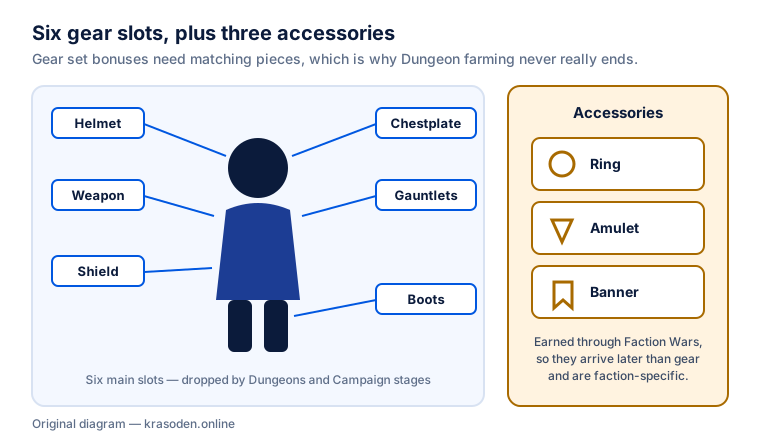
Each Champion wears six pieces of gear and three accessories. Gear belongs to sets, and wearing enough matching pieces grants a set bonus — extra speed, extra critical rate, life steal and so on. The substatistics on each individual piece are randomised when it drops and randomised again each time you upgrade it, which means good gear is not found so much as eventually manufactured out of a great deal of mediocre gear.
Accessories come from Faction Wars rather than the ordinary Dungeons, and they are faction-specific, so they arrive much later in an account’s life. This is a deliberate piece of pacing: it keeps a mode relevant long after its rewards would otherwise be trivial.
If you take one practical thing from this section: gear is the real progression system in RAID. Champion acquisition gets all the marketing, but a well-geared Rare beats a badly geared Legendary in most fights that matter.
Try the first Dungeon tier yourself
The affinity, gear and team-role systems described above are all unlocked inside the first few hours. Downloading costs nothing and needs no payment details.
Get RAID: Shadow Legends freePartner link · advertisementPartner link. If you install the game through it, BUILDKEPITEL WORK s.r.o. receives a commission from the advertiser. The game itself stays free to download and it costs you nothing extra.Masteries and the long tail
Beyond levels and gear, each Champion has Mastery trees — offensive, defensive and support branches that you fill in with scrolls earned from a specific Dungeon. Masteries are shared systems rather than bespoke skill trees: every Champion picks from the same set of nodes, and the craft is in choosing which nodes suit that Champion’s job.
This is the part of the game that has no end. Ascension, Mastery scrolls, gear upgrades and Champion ranking all consume resources faster than a free account generates them, indefinitely. That is not a criticism — it is the design — but it is worth knowing that “finished” is not a state this game offers.
The modes, and what each one costs you in time
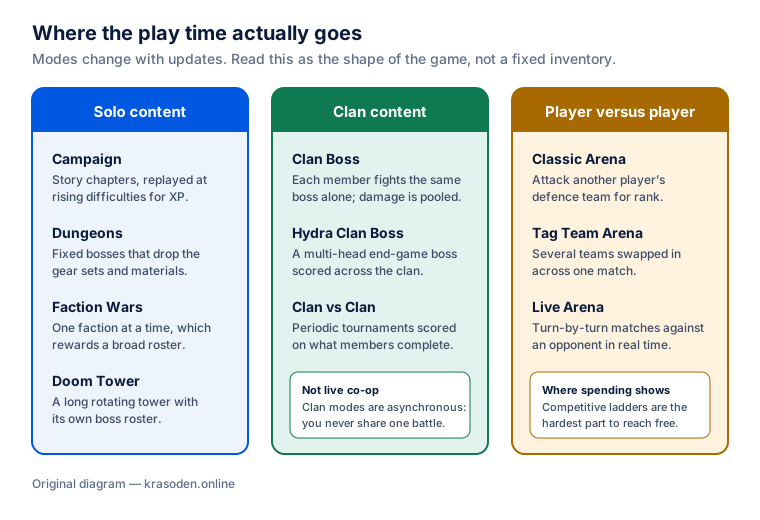
Solo content
The Campaign is a series of chapters replayed across rising difficulty tiers; late Campaign stages on the harder tiers are the standard experience farm and the place most players park their account for weeks. Dungeons are repeatable fixed bosses that drop the gear sets and upgrade materials. Faction Wars asks for single-faction teams. Doom Tower is a long rotating tower with its own boss roster and its own gear.
Clan content
Clan modes are asynchronous, and this is the most widely misreported thing about the game. You do not fight alongside other players in a shared battle. In Clan Boss and the Hydra Clan Boss, each member fights their own instance of the same enemy and the results are pooled into a clan score; Clan vs Clan tournaments score what members complete individually over a set period. Joining an active clan is nonetheless the single largest free boost available to a new account, because the reward chests scale with what the whole clan does.
Player versus player
Classic Arena pits your team against another player’s defence team for ladder position. Tag Team Arena swaps several teams through one match. Live Arena is a turn-by-turn match against a real opponent. PvP is where account investment shows most plainly, and it is the part of the game least accessible to a player who never spends.
Money: what it buys, and what it does not
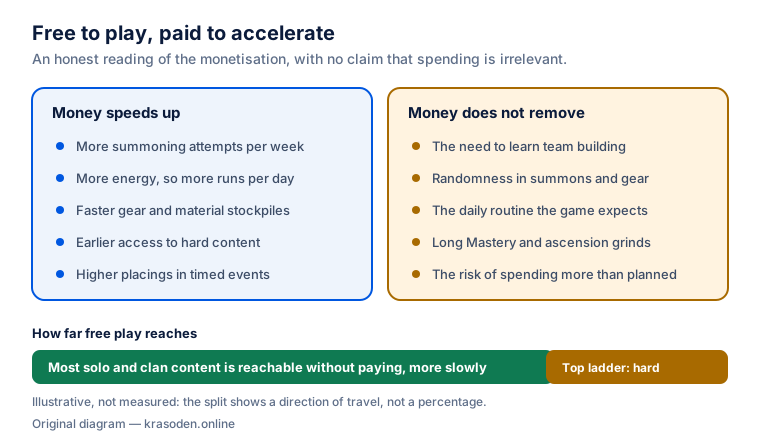
Let us be direct, because a lot of pages about this game are not. RAID: Shadow Legends is free-to-play and a patient player can reach most of the solo and clan content without paying anything. It is not a game where money is irrelevant. Purchases buy more summoning attempts, more energy and therefore more runs per day, and a faster route to the gear that end-game content demands. In the competitive ladders, heavily invested accounts dominate the top brackets. Any page telling you that spending confers no advantage is selling you something.
The purchases themselves fall into a few groups: random Champion summons (the classic gacha mechanic), direct resource packs, a seasonal battle pass, and recurring subscriptions that top up energy and currency daily. Because summons are random, the amount you would need to spend to obtain a specific Champion is not knowable in advance. Plarium publishes the summoning probabilities inside the game’s own summon interface; read them there, and treat any figure quoted by a third-party site — including this one, which quotes none — with suspicion.
Decide a monthly ceiling before you open a summon screen, not during one. Random-reward systems are specifically designed to make “one more” feel cheap. Both major mobile stores let you disable in-app purchases or require authentication for every transaction, and that setting is worth turning on before handing a device to a teenager. Rules on paid random-item mechanics differ across the EU and some member states restrict them; availability and payment options may vary by country.
A realistic first month
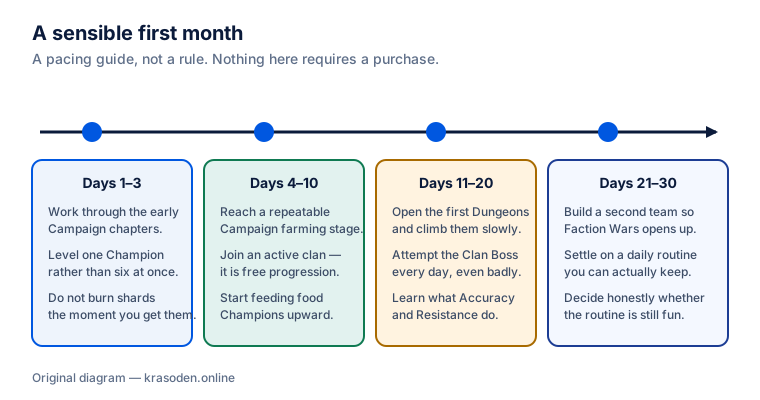
Nothing in the schedule above is mandatory, and there is no prize for keeping to it. It exists because the most common way new accounts fail is not bad luck with summons — it is spreading resources across too many Champions in week one and hitting a wall in week three with nothing finished.
The one genuinely time-sensitive piece of advice is to join an active clan early. Clan chests are free progression and they are the largest single lever a non-paying account has.
Who it suits — and who should skip it
| You will probably enjoy it if… | You should probably skip it if… |
|---|---|
| You like optimising numbers and reading skill descriptions carefully. | You want a game you can finish and put down. |
| You are happy with a short, repeatable daily routine. | Daily log-in obligations make you resentful. |
| You enjoy long-horizon collection games. | Random rewards are a problem for you, financially or otherwise. |
| You will join a clan and talk to people. | You want live co-operative play — this game does not have it. |
| You accept slow progress without paying. | You want to be competitive in PvP quickly without spending. |
Claims about this game that are simply wrong
An earlier version of this page repeated several claims that do not survive checking. We have corrected them, and we are listing them rather than quietly deleting them, because a page that only ever agreed with itself would not be worth reading. The full log lives on our sources and corrections page.
- “Released in 2019.” The mobile launch was in 2018; a desktop client came later. Corrected.
- “A team of up to five heroes.” Most content is fought with four Champions. Some modes use five. Corrected.
- “Over 300 heroes.” The roster is in the several hundreds and grows with updates. We now point readers at the in-game collection screen instead of printing a number that ages.
- “Dungeon is a co-op mode where you team up with other players.” Dungeons are solo. No mode in the game is live co-operative play. Corrected.
- “Players trade heroes.” There is no Champion trading in RAID: Shadow Legends. Removed.
- “Clan Wars, every few weeks.” The clan modes are Clan Boss, Hydra Clan Boss and Clan vs Clan. Corrected.
- “In-app purchases never create a pay-to-win situation.” Misleading. Spending materially accelerates progress and dominates the competitive ladders. Rewritten in full — see Money.
- “Millions of active players.” Unsourced. Removed; store listings carry current download counts if you want one.
- “Every hero has a unique skill tree.” Skills are unique; the Mastery trees are shared systems. Corrected.
- Reader-story framing and event urgency. This page was previously presented as a reader-submitted story and used artificial-urgency language about limited-time events. Both are gone. The page carries a named byline and a date instead.
Sources, and how to check us
Everything above is either (a) directly observable in the game within the first few hours, (b) published by the developer, or (c) explicitly marked as our opinion. We do not print statistics we cannot point at.
- The developer’s own product and support material at plarium.com and the game’s official site.
- The in-game summoning interface, which displays current probabilities for random summons.
- The Google Play and Apple App Store listings, for platform support, age rating, download counts and the current in-app purchase range in your own currency.
- Patch notes and update announcements published by the developer, for mode availability.
- Direct play, for everything described as a mechanic.
The publisher’s own information prevails. Game systems, rewards, prices, mode availability and the Champion roster change with every update. Where anything on this page conflicts with what Plarium currently publishes or with what you see in the game, the developer’s information is correct and ours is out of date. Tell us and we will fix it — info@krasoden.online.
RAID: Shadow Legends is a trademark of its respective owner. krasoden.online, operated by BUILDKEPITEL WORK s.r.o., is an independent, advertising-funded publication and is not affiliated with, endorsed by or sponsored by Plarium, Aristocrat Leisure or any other rights holder. Brand names are used here for identification and commentary only. All illustrations on this page are original diagrams created by us; this page contains no product screenshots, logos or artwork belonging to the rights holder.
Ready to start?
RAID: Shadow Legends is a free download on mobile and PC. Everything described on this page — affinities, gear sets, the daily loop — is visible without spending anything.
Play RAID: Shadow LegendsPartner link · advertisementPartner link. If you install the game through it, BUILDKEPITEL WORK s.r.o. receives a commission from the advertiser. The game itself stays free to download and it costs you nothing extra.